

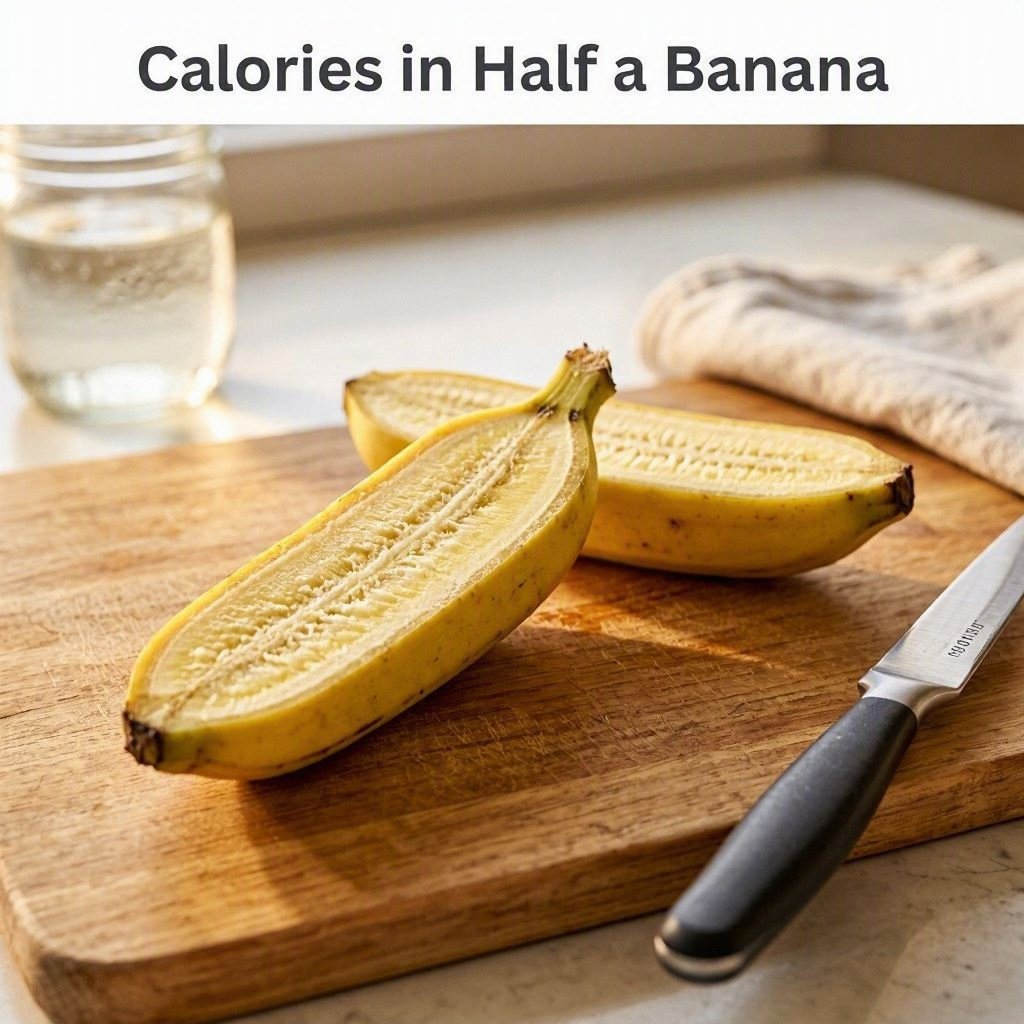
Calories in half banana add up to about 53, based on a medium-sized fruit — that works out to roughly 105 calories for the whole banana, or 89 calories per 100g. Exact numbers shift with size and ripeness, since a banana can range from a small 6-inch fruit to a large 9-inch one, but half a medium banana lands consistently in the 45–55 calorie range across independent nutrition databases.
Calories in Half Banana by Size
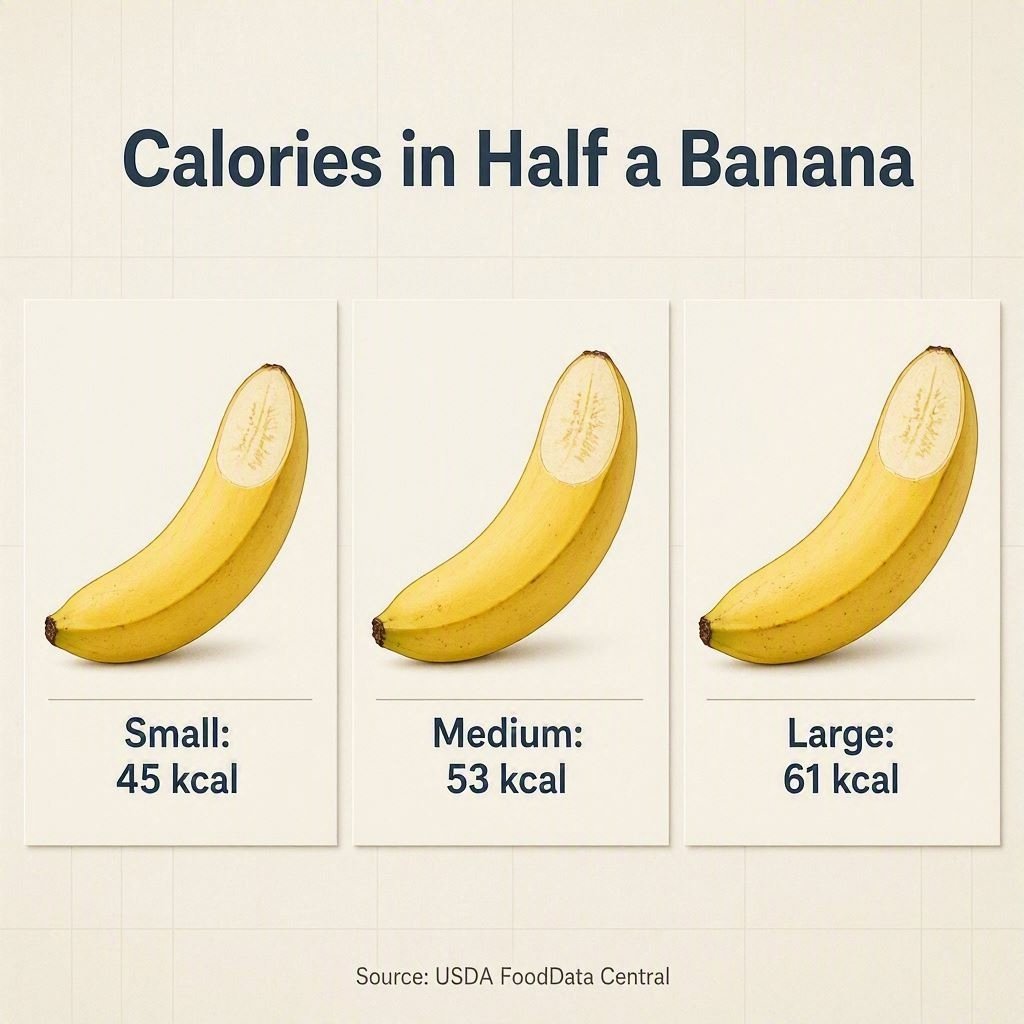
Bananas vary a lot in size, which matters more here than it does for most fruit — a “medium” banana can weigh anywhere from about 100g to 130g depending on the bunch. Here’s how the numbers break down, based on USDA FoodData Central figures for raw banana.
| Serving | Weight | Calories | Carbs | Fiber | Sugar |
|---|---|---|---|---|---|
| 100g | 100g | 89 | 22.8g | 2.6g | 12.2g |
| 1/2 small banana | ~50g | 45 | 11.4g | 1.3g | 6.1g |
| 1/2 medium banana | ~59g | 53 | 13.5g | 1.5g | 7.2g |
| 1/2 large banana | ~68g | 61 | 15.5g | 1.8g | 8.3g |
| 1 whole small banana | ~101g | 90 | 23.0g | 2.6g | 12.3g |
| 1 whole medium banana | ~118g | 105 | 26.9g | 3.1g | 14.4g |
| 1 whole large banana | ~136g | 121 | 31.1g | 3.5g | 16.6g |
| 1 cup, sliced | ~150g | 134 | 34.2g | 3.9g | 18.3g |
If you’re logging “half a banana” without weighing it, 53 calories (medium) is the safest default — it’s what most nutrition trackers assume unless you specify a different size.
Full Nutrient Profile Per 100g
Calories are only part of why bananas show up so often in nutrition advice. Here’s the fuller picture for a standard 100g serving:
| Nutrient | Amount per 100g | % Daily Value* |
|---|---|---|
| Calories | 89 | 4% |
| Carbohydrates | 22.8g | 8% |
| Fiber | 2.6g | 9% |
| Sugar | 12.2g | — |
| Protein | 1.1g | 2% |
| Fat | 0.3g | <1% |
| Potassium | 358mg | 8% |
| Vitamin B6 | 0.4mg | 22% |
| Vitamin C | 8.7mg | 10% |
Based on a 2,000-calorie diet. Values from USDA FoodData Central.
That vitamin B6 figure stands out — bananas are one of the more concentrated everyday sources of it, which is part of why they show up so often in recovery and energy-focused eating patterns.
Green vs. Ripe Banana: Does Ripeness Change the Calorie Count?
Barely, if at all — but it changes what kind of carbohydrate you’re eating, which matters more than the calorie number itself for some people.
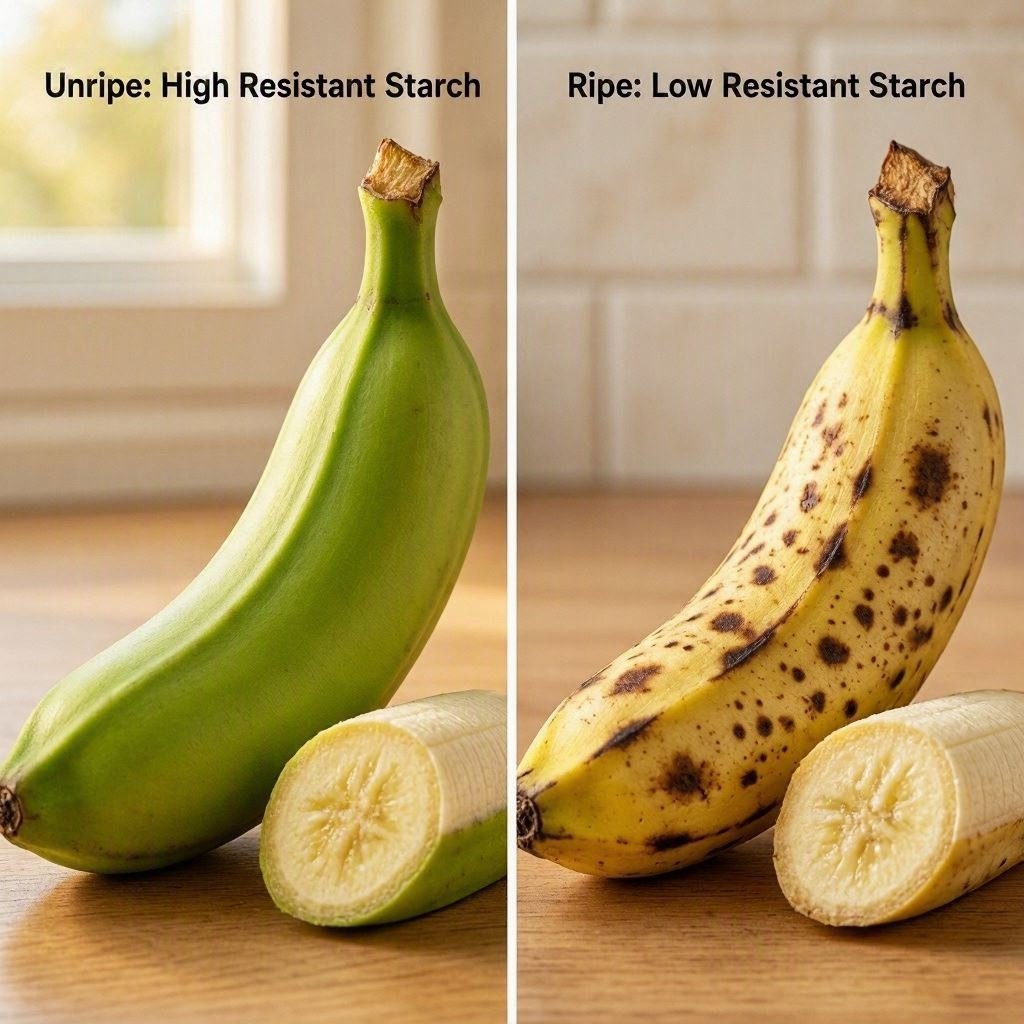
- Green (unripe) bananas are mostly resistant starch, which behaves more like fiber than sugar in the body — it passes through the small intestine largely undigested.
- Ripe (yellow, spotted) bananas have converted most of that starch into simple sugars (glucose, fructose, sucrose) as they ripened.
- Total calories stay roughly the same either way, since the conversion is starch-to-sugar, not a gain or loss of energy content.
The practical difference shows up in digestion speed and blood sugar response, not in the calorie count on the label.
How Half a Banana Compares to Other Fruit
Per 100g, banana sits toward the higher end of common fruit — more calorie-dense than most berries and citrus, though still far below avocado.
| Fruit (per 100g) | Calories |
|---|---|
| Strawberries | 32 |
| Grapefruit | 42 |
| Apple | 52 |
| Grapes | 69 |
| Banana | 89 |
| Avocado | 160 |
That higher calorie density comes with more staying power — bananas pack more carbohydrate energy per bite than lighter fruits like strawberries or grapefruit, which is part of why they’re a common pre- or post-workout choice.
Why the Calorie Count Can Vary
A few things shift the number more than people expect:
- Size within “medium” — a “medium” banana can range from about 100g to 130g depending on the bunch, which alone shifts the whole-fruit calorie count by 25–30 calories.
- Ripeness — has a negligible effect on total calories, despite the sugar content changing noticeably (see above).
- Whether it’s mashed or blended — mashing or blending doesn’t add calories, but it does make it easier to eat a larger volume in one sitting than you would biting into a whole banana, which is worth knowing if you’re tracking intake by “servings” rather than weight.
- Dried vs. fresh — this is the one that actually matters a lot. Drying concentrates the sugar and removes water weight, pushing dried banana to roughly 350 calories per 100g, and banana chips (often fried) can exceed 500 calories per 100g.
Banana, Blood Sugar, and the Glycemic Index
This is where ripeness actually matters. An unripe, green banana has a glycemic index around 30, solidly in low-GI territory, thanks to its resistant starch content. A fully ripe, spotted banana climbs to a GI of roughly 51–60 — medium range — as that starch converts to simple sugar.
A few practical notes:
- If you’re managing blood sugar closely, a less-ripe banana (yellow with minimal spotting) has a meaningfully lower glycemic impact than an overripe one.
- Pairing with protein or fat — a small handful of nuts or a spoonful of nut butter — slows the rise in blood sugar regardless of ripeness.
- The glycemic load of a medium banana is moderate (roughly 11–13), meaning even a fully ripe banana eaten in a normal portion isn’t an extreme sugar spike on its own.
This is general nutrition information, not medical advice — if you have diabetes or another blood sugar condition, talk to your doctor or care team about how bananas fit your specific plan.
Best Ways to Eat Half a Banana Without Adding Calories
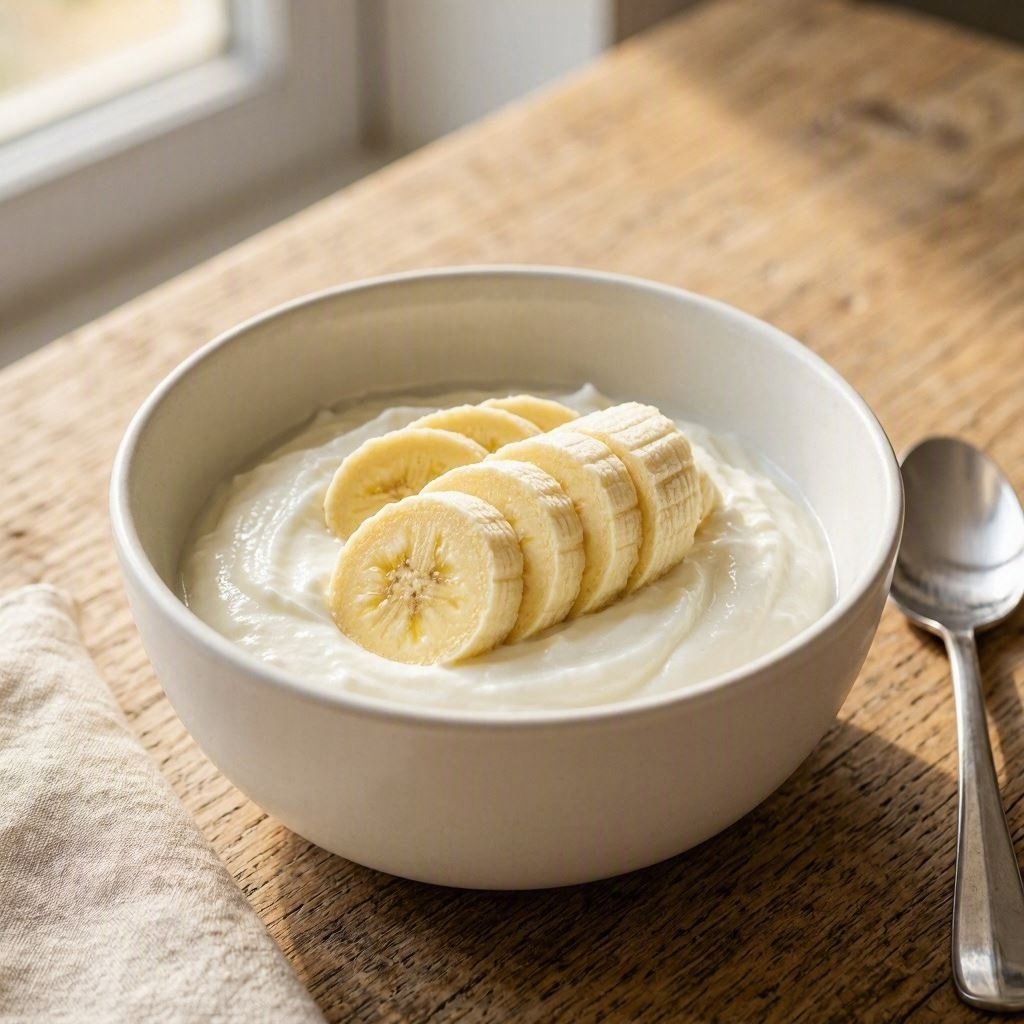
- Pair it with protein, like Greek yogurt, cottage cheese, or a spoonful of nut butter, rather than eating it alongside another high-carb food.
- Freeze it for smoothies instead of using a whole banana — frozen half-portions make it easy to control the exact amount going in.
- Slice it onto oatmeal or cereal rather than adding sweeteners — the natural sugar in half a banana is often enough on its own.
- Skip the chocolate or caramel dip if you’re watching calories — the banana itself is the low-calorie part; toppings are where the calories usually pile up.
Storage and Prep Tips
- Whole, unpeeled bananas keep at room temperature for about 2–7 days depending on ripeness when purchased.
- Half a banana, cut, browns quickly — a squeeze of lemon or lime juice on the cut surface slows oxidation if you’re saving the other half for later.
- Freezing works well for portion control — peel, halve or slice, and freeze in a sealed bag or container for up to 2–3 months.
- Very ripe bananas (heavily spotted or browning) are ideal for baking, since their concentrated sugar means less added sweetener is needed in recipes.
FAQ
How many calories are in half a small banana?
Half a small banana (about 50g) has roughly 45 calories, along with about 1.3g of fiber and 6.1g of natural sugar.
Is half a banana a good pre-workout snack?
Half a banana provides quick-digesting carbohydrate and a modest amount of potassium, which is why it’s a common pre-workout choice — though a whole banana or a banana with a small amount of protein is more common for longer workouts.
Does a green banana have fewer calories than a ripe one?
No — the calorie count stays roughly the same either way. What changes is the type of carbohydrate: green bananas are higher in resistant starch, while ripe bananas have more simple sugar.
How many calories are in a frozen banana?
Freezing doesn’t change the calorie content — a frozen half banana has the same roughly 53 calories (medium size) as a fresh one, since freezing only removes nothing but water mobility, not mass or energy content.
Are banana chips the same calories as fresh banana?
No — banana chips are usually fried and dehydrated, which concentrates the sugar and adds fat from frying, pushing them to over 500 calories per 100g compared to 89 for fresh banana.
Is half a banana good for blood sugar?
Half a banana has a moderate amount of natural sugar, and the glycemic impact depends heavily on ripeness — a less-ripe half banana has a meaningfully lower effect on blood sugar than an overripe one.
How many calories are in half a large banana?
Half a large banana (about 68g) has roughly 61 calories, a bit more than the 53 calories in half a medium banana.
Which has fewer calories, half a banana or half an apple?
Half a medium apple (about 91g) has roughly 47 calories, slightly fewer than half a medium banana’s 53 — bananas are more calorie-dense per 100g overall (89 vs. 52), but a typical banana half is smaller in weight than an apple half.

Bottom line: calories in half banana come out to roughly 53 for a medium fruit no matter how it’s prepared, whether you eat it fresh, freeze it, or mash it — it’s the toppings and pairings around it that tend to change the total more than the banana itself.
Related reading: Avocado Calories Per 100g · Calories for a Grapefruit · Browse the Calories category
Sources:
- U.S. Department of Agriculture, FoodData Central — Bananas, raw
- Harvard T.H. Chan School of Public Health, The Nutrition Source — Bananas
Reviewed by Chloe MacAllister, Certified Sports Nutritionist · Last updated August 31, 2026



 Trudy Banks
 Chloe MacAllister