

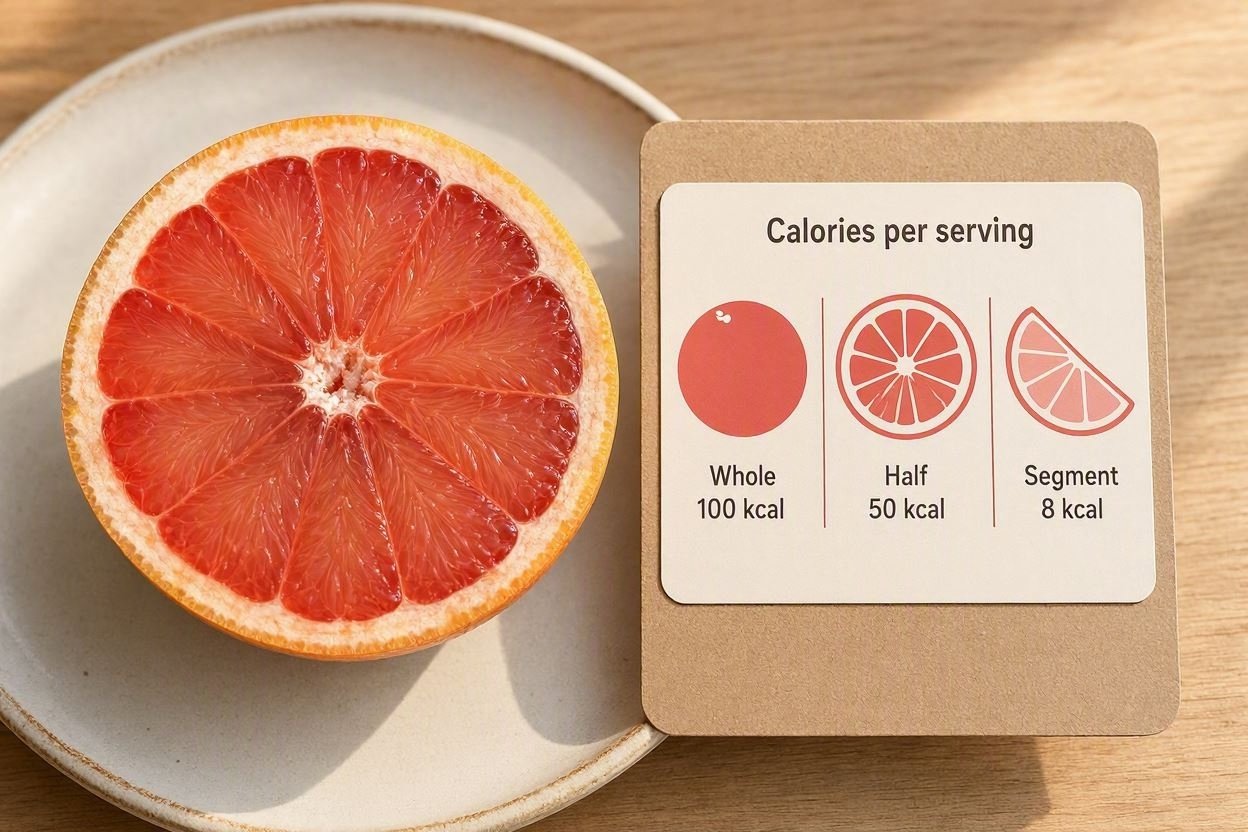
There are about 42 calories for a grapefruit per 100g serving, which works out to about 48 calories for half a medium grapefruit and around 118 calories for a whole large one. Exact numbers shift a little depending on the variety — pink and red grapefruit run slightly higher in natural sugars than white — but grapefruit stays one of the lowest-calorie whole fruits you can eat.
Calories for a Grapefruit by Serving Size
Here’s how the numbers break down across the servings people actually eat, based on USDA FoodData Central figures for raw pink and red grapefruit.
| Serving | Calories | Carbs | Fiber | Sugar |
|---|---|---|---|---|
| 100g | 42 | 10.7g | 1.6g | 6.9g |
| 1 section (~48g) | 20 | 5.1g | 0.8g | 3.3g |
| 1/2 grapefruit (~115g) | 48 | 12.3g | 1.8g | 7.9g |
| 1 medium whole (~230g) | 97 | 24.6g | 3.7g | 15.9g |
| 1 large whole (~280g) | 118 | 30.0g | 4.5g | 19.3g |
| 1 cup segments (~230g) | 97 | 24.6g | 3.7g | 15.9g |
White grapefruit runs slightly lower across the board — about 2g less carbohydrate per 100g than pink or red varieties.
Full Nutrient Profile Per 100g
Calories are only part of the picture. Here’s what else you’re getting in a standard 100g serving of pink or red grapefruit:
| Nutrient | Amount per 100g | % Daily Value* |
|---|---|---|
| Calories | 42 | 2% |
| Carbohydrates | 10.7g | 4% |
| Fiber | 1.6g | 6% |
| Sugar | 6.9g | — |
| Protein | 0.8g | 2% |
| Fat | 0.1g | <1% |
| Vitamin C | 31.5mg | ~35% |
| Potassium | 135mg | 3% |
Based on a 2,000-calorie diet. Values from USDA FoodData Central.
That vitamin C figure is a big part of why grapefruit shows up so often in low-calorie eating plans — you’re getting over a third of a day’s requirement for under 45 calories.
Pink, Red, or White: Does Variety Change the Calorie Count?
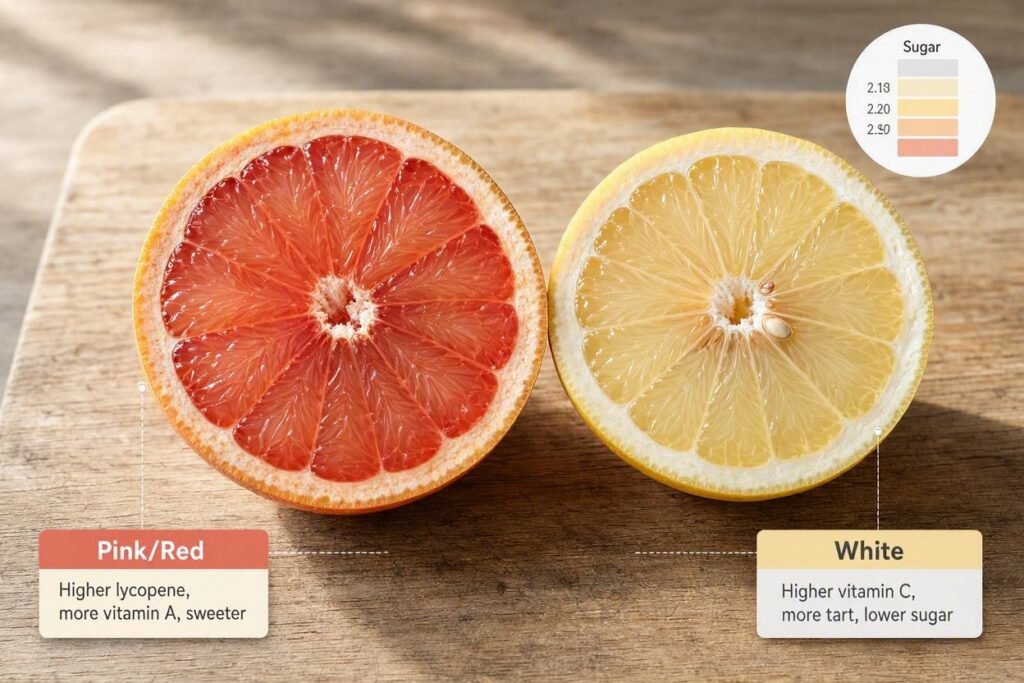
Not by much. The calorie gap between grapefruit varieties comes down to sugar content, not some meaningful metabolic difference:
- Pink and red grapefruit: ~42 calories per 100g, slightly sweeter, higher in lycopene and beta carotene
- White grapefruit: ~2g less carbohydrate per 100g, more tart, still under 40 calories per 100g
If you’re tracking calories closely, the difference between varieties is small enough that portion size matters far more than which color you pick.
How Grapefruit Compares to Other Fruit
Per 100g, grapefruit sits among the lighter fruits on a calorie basis:
| Fruit (per 100g) | Calories |
|---|---|
| Grapefruit | 42 |
| Strawberries | 32 |
| Green grapes | 69 |
| Apple | 52 |
| Banana | 89 |
| Avocado | 160 |
Grapefruit lands between strawberries and grapes on calorie density — lower than most stone fruit and dramatically lower than avocado, which gets most of its calories from fat rather than sugar. It’s also noticeably lighter than a banana, which is worth knowing if you’re choosing between the two as a lower-calorie option with similar staying power.
Why the Calorie Count Can Vary
A few things move the number more than people expect:
- Ripeness — riper fruit has slightly higher sugar content, which nudges calories up a little.
- Size within “medium” — a “medium” grapefruit can range from 190g to 260g depending on the batch, which alone shifts the calorie count by 20–30 calories.
- How you eat it — plain grapefruit versus grapefruit sprinkled with sugar or broiled with brown sugar (a common preparation) can add 20–50 extra calories per serving, all from the topping, not the fruit itself.
- Juice versus whole fruit — juicing strips out the fiber and concentrates the sugar into a smaller volume, so it’s easy to consume several servings’ worth of calories in one glass without the fullness that eating the whole fruit provides.
A Safety Note: Grapefruit and Medication
This is worth knowing regardless of calorie count: grapefruit can interact with a range of common prescription medications. The section below goes into the specific drug classes and why — but the short version is: if you take any prescription medication, check with a pharmacist before making grapefruit a daily habit.
Grapefruit, Blood Sugar, and the Glycemic Index
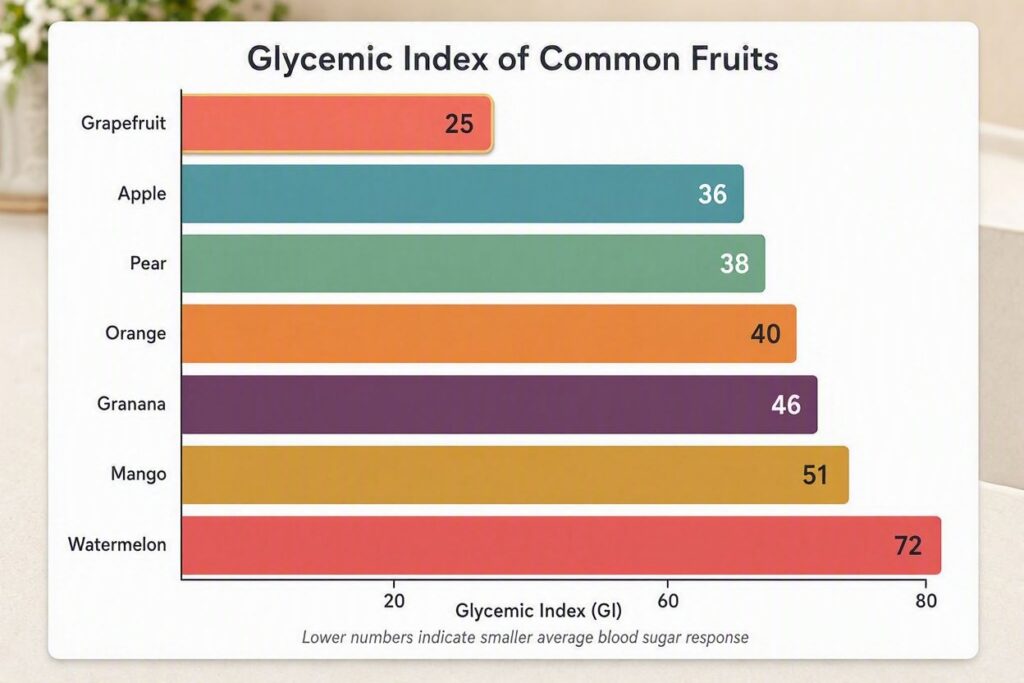
If you’re watching calories, you may also care how a food affects blood sugar — and grapefruit does well here too. It’s considered a low-glycemic-index food, generally cited in the mid-20s to high-20s range depending on the source and testing method, which puts it well below foods like white bread or watermelon. In general, the glycemic index measures how quickly a food raises blood sugar after eating, and lower-fiber, more processed foods tend to score higher, while fiber-rich whole foods like grapefruit score lower.
A few things worth knowing:
- Raw, whole grapefruit has the lowest glycemic impact of any form of the fruit — the fiber slows sugar absorption.
- Canned grapefruit in juice and grapefruit juice score meaningfully higher, since processing and juicing strip out fiber and concentrate sugar.
- Some small studies have looked at grapefruit’s effect on insulin sensitivity specifically, with mixed and inconclusive results — worth knowing if you see strong claims about grapefruit “burning fat” or dramatically lowering blood sugar, since the evidence for that specific effect is weaker than the evidence for its low glycemic index generally.
If you have diabetes or another condition affecting blood sugar, this is general nutrition information, not a treatment recommendation — check with your doctor or care team before using glycemic index values to guide food choices.
A Deeper Look: Grapefruit and Medication Interactions
The calorie count is the easy part of this fruit — the medication interaction is the part worth actually understanding, not just glancing past.
Grapefruit contains compounds (furanocoumarins) that inhibit an enzyme in the intestinal wall called CYP3A4, which is responsible for breaking down a wide range of medications before they reach the bloodstream. When that enzyme is blocked, more of the drug gets absorbed than intended — sometimes significantly more — which can push blood levels of the medication into a range that causes side effects, even at a normal prescribed dose.
Medicine categories commonly flagged for this interaction include:
- Statins (cholesterol medication) — atorvastatin and simvastatin in particular
- Calcium channel blockers for blood pressure — including some dihydropyridine-class drugs
- Immunosuppressants — including cyclosporine, used after organ transplants
- Some anti-anxiety and antihistamine medications
- Certain antiarrhythmic drugs used for irregular heartbeat
This isn’t a matter of “just eat grapefruit at a different time than your pills” — because the enzyme inhibition can last much longer than the time it takes to digest the fruit, spacing them out often doesn’t solve the problem the way it does with other food-drug interactions. If a medication interacts with grapefruit, that’s typically noted directly on the packaging or pharmacy insert, and it’s worth a direct conversation with a pharmacist rather than guessing.
None of this makes grapefruit unsafe for the general population — it’s a well-known, well-documented interaction that affects a specific list of drug classes, not a reason to avoid the fruit if you’re not on one of them.
Best Ways to Eat Grapefruit Without Adding Calories
- Eat it plain or with a pinch of salt instead of sugar — salt cuts the bitterness for a lot of people without adding calories the way sugar does.
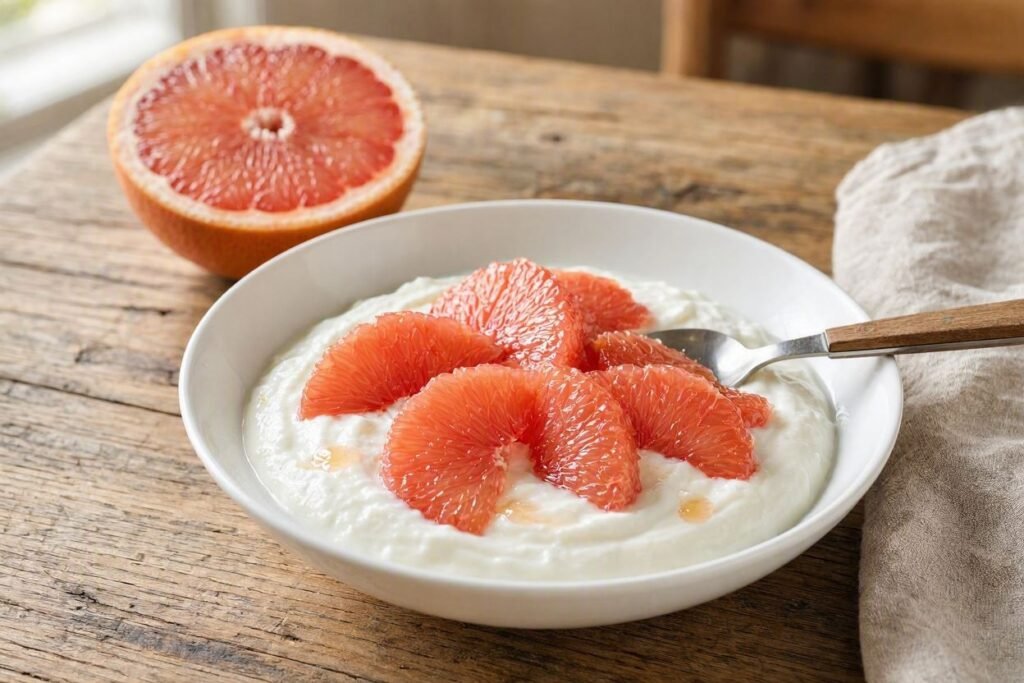
- Pair it with protein (like Greek yogurt or eggs) rather than carbs — this is a common approach in lower-calorie eating plans since it adds staying power without much added calorie load.
- Skip the broiled-with-brown-sugar prep if you’re watching calories closely — it’s a popular way to serve grapefruit, but it can add nearly as many calories as the fruit itself already has.
- Use segments, not juice, if the goal is to stay full on fewer calories — the fiber is the whole point.
Storage and Prep Tips
- Whole grapefruit keeps at room temperature for about a week, or up to 3 weeks refrigerated.
- Cut grapefruit should be covered and refrigerated, and eaten within 2–3 days for best texture.
- Segmenting ahead of time (removing the membrane) makes it easier to control portions if you’re tracking calories by the cup rather than by the fruit.
- A heavier grapefruit for its size usually means more juice — a useful way to pick a good one at the store without needing a scale.
Bottom line: calories for a grapefruit stay low no matter which size, variety, or serving you choose, which is part of why it’s such an easy fit for so many different ways of eating.
FAQ
How many calories are in half a grapefruit?
Half a medium grapefruit (about 115g) has roughly 48 calories, along with about 1.8g of fiber and around 40% of a day’s vitamin C.
Is grapefruit good for weight loss?
Grapefruit is low in calories and high in water and fiber, which can support a lower-calorie eating pattern. Research hasn’t found it has any special fat-burning effect on its own — the benefit comes from it being a filling, low-calorie swap for higher-calorie snacks.
Does grapefruit juice have the same calories as the whole fruit?
No — juicing removes most of the fiber and concentrates the sugar, so a cup of grapefruit juice runs noticeably higher in calories than a cup of grapefruit segments, with less of the fullness benefit.
Can I eat grapefruit every day?
For most people, yes — but check with a doctor or pharmacist first if you take any prescription medication, since grapefruit is known to interact with several common drug classes.
Does broiled grapefruit have more calories than raw grapefruit?
The fruit itself doesn’t change, but broiling it with the traditional brown sugar topping can add 20–50 calories per half, depending on how much sugar is used.
Which has fewer calories, grapefruit or an orange?
They’re close — a medium orange runs about 62 calories versus roughly 97 for a medium grapefruit, but grapefruit is larger on average, so per-100g grapefruit is actually the lower-calorie choice at 42 versus about 47 for orange.
Is grapefruit safe for people with diabetes?
Grapefruit is generally considered a good low-glycemic-index fruit choice, but this is general nutrition information, not medical advice — check with your doctor or care team for guidance specific to your situation.
Why does grapefruit interact with medication when other citrus fruits don’t as much?
Grapefruit contains a higher concentration of compounds called furanocoumarins than most other citrus fruits, which is what blocks the CYP3A4 enzyme responsible for breaking down many medications in the gut.
Sources:
- U.S. Department of Agriculture, FoodData Central — Grapefruit, raw, pink and red
- Mayo Clinic — Grapefruit: Beware of dangerous medication interactions
- Harvard Health Publishing — The lowdown on glycemic index and glycemic load
Related reading: How Many Calories in a Strawberry? · How Many Calories Does a Green Grape Have? · Browse all our Calorie Guides.
Reviewed by Chloe MacAllister, Certified Sports Nutritionist · Last updated August 31, 2026






 Trudy Banks
 Chloe MacAllister