

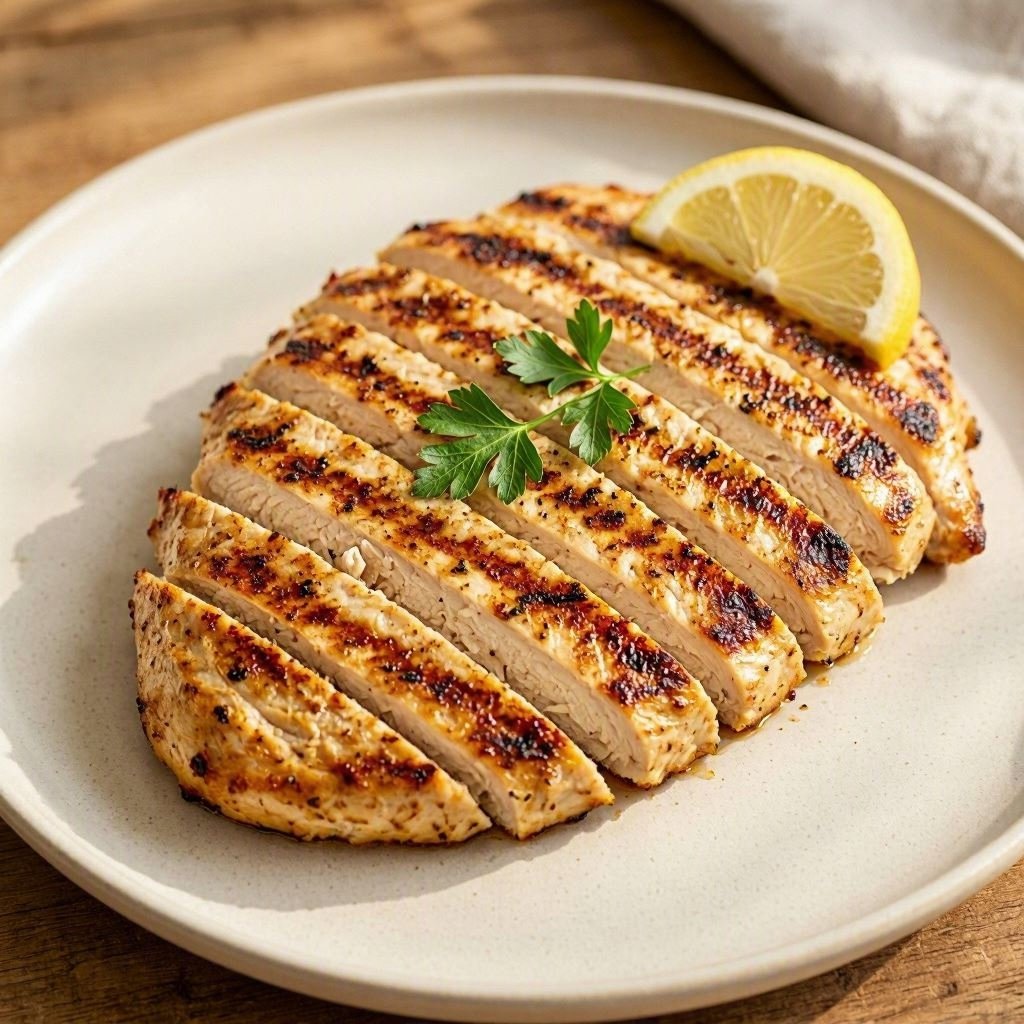
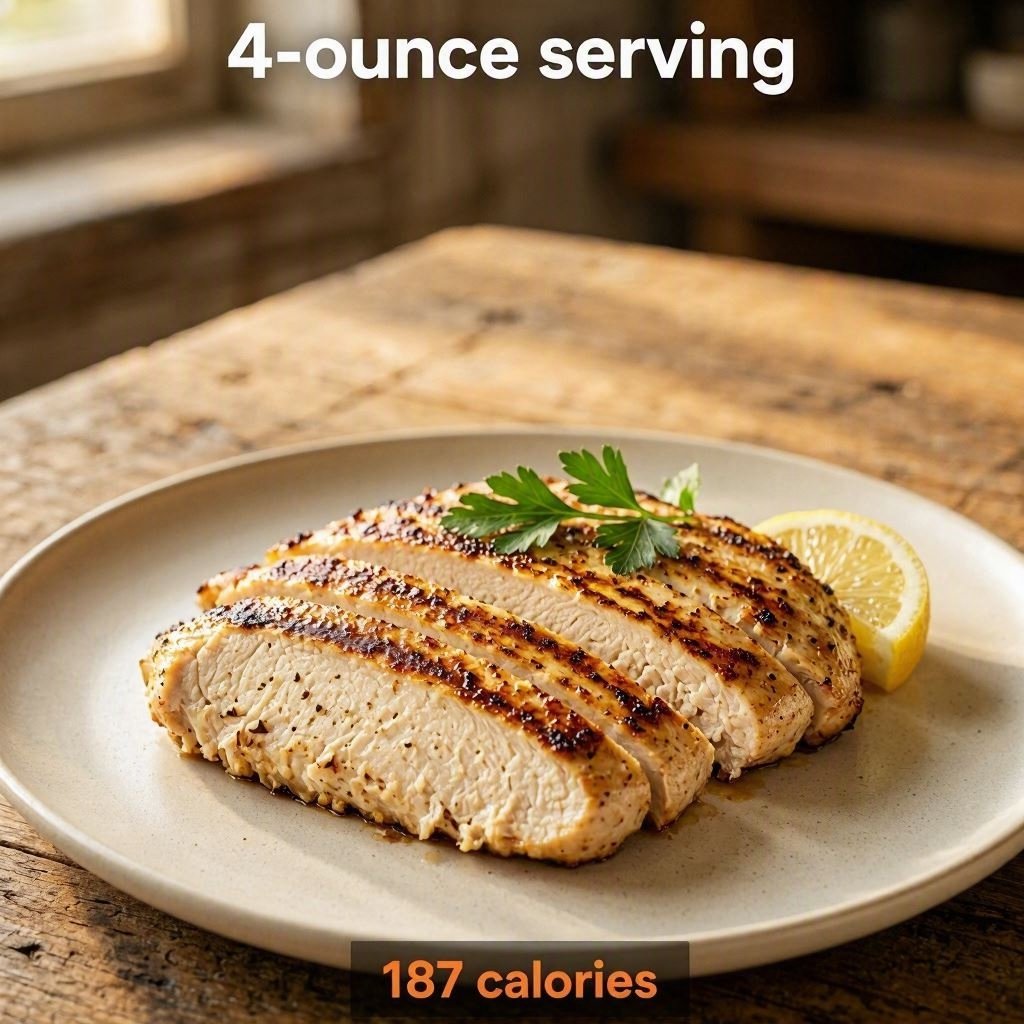
Calories in grilled chicken breast come to about 165 per 100g, or roughly 187 for a standard 4-ounce portion — one of the leanest, most protein-dense foods you can put on a plate. Exact numbers shift a bit with portion size and whether the skin is left on, but plain, skinless grilled chicken breast lands consistently in this range across independent nutrition databases.
Calories in Grilled Chicken Breast by Serving Size
Chicken breasts vary more in size than most foods people track — a single breast can run anywhere from 4 ounces to 10 ounces or more. Here’s how the numbers break down, based on skinless, boneless chicken breast cooked by grilling, baking, or roasting (all dry-heat methods that add essentially no calories on their own).
| Serving | Weight | Calories | Protein | Fat | Carbs |
|---|---|---|---|---|---|
| 100g | 100g | 165 | 31g | 3.6g | 0g |
| 1 oz | 28g | 46 | 8.7g | 1g | 0g |
| 3 oz | 85g | 140 | 26.4g | 3.1g | 0g |
| 4 oz | 113g | 187 | 35g | 4.1g | 0g |
| 6 oz | 170g | 281 | 53g | 6.1g | 0g |
| 8 oz | 227g | 375 | 70g | 8.2g | 0g |
| 1 cup, diced | 140g | 231 | 43g | 5g | 0g |
If you’re not weighing your chicken, 4 ounces — roughly the size of a deck of cards or the palm of your hand — is the most common reference portion used across nutrition trackers.
Full Nutrient Profile Per 100g
Calories only tell part of the story with chicken breast — it’s the nutrient density that makes it such a staple in high-protein eating patterns. Here’s the fuller picture for a standard 100g serving of grilled, skinless chicken breast:
| Nutrient | Amount per 100g | % Daily Value* |
|---|---|---|
| Calories | 165 | 8% |
| Protein | 31g | 62% |
| Fat | 3.6g | 5% |
| Saturated Fat | 1g | 5% |
| Carbohydrates | 0g | 0% |
| Cholesterol | 85mg | 28% |
| Sodium | 74mg | 3% |
| Potassium | 256mg | 5% |
| Vitamin B6 | 0.6mg | 35% |
| Niacin | 13.7mg | 86% |
Based on a 2,000-calorie diet. Values from USDA FoodData Central.
That niacin figure is worth noting — chicken breast is one of the most concentrated everyday sources of it, alongside a substantial dose of vitamin B6, both of which play a role in energy metabolism.
Grilled vs. Other Cooking Methods: Does It Change the Calorie Count?
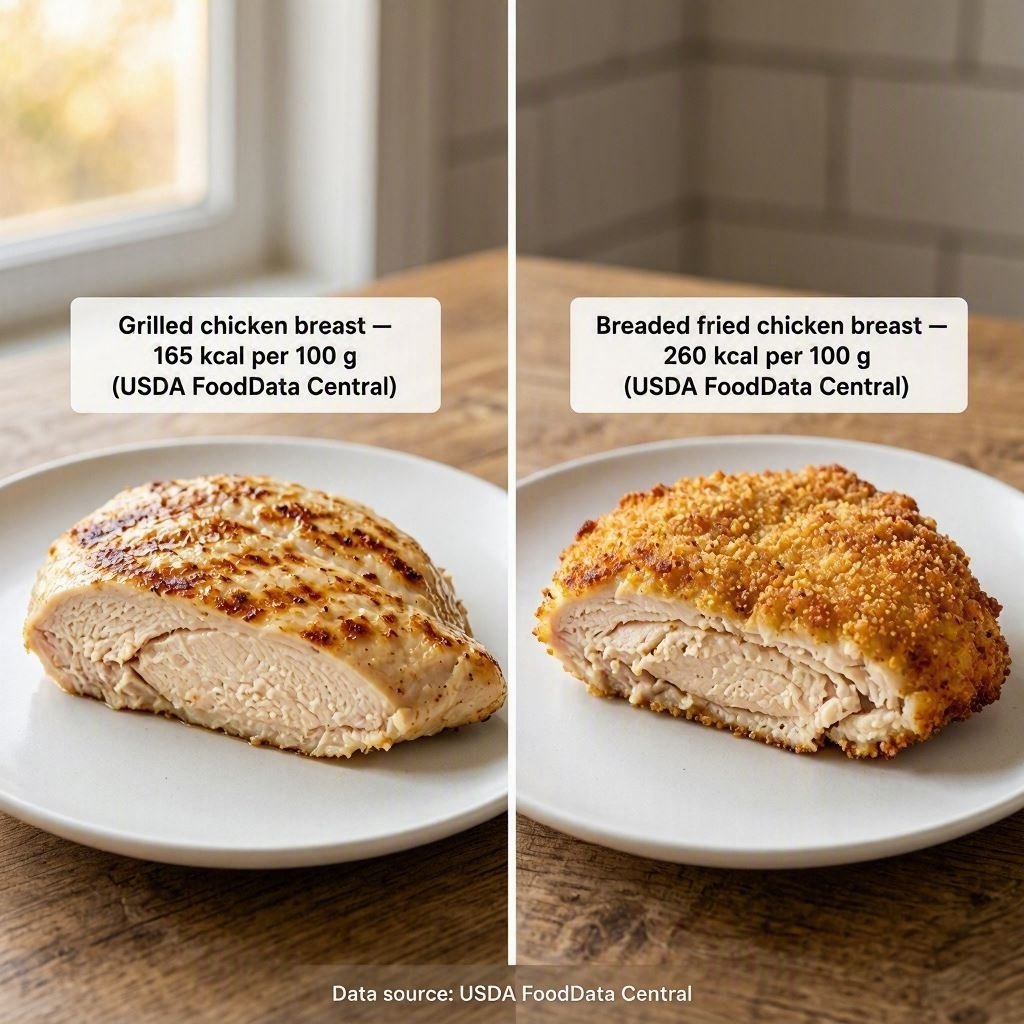
Significantly, and this is where a lot of the confusion around “chicken breast calories” comes from — the cut itself doesn’t change, but how it’s prepared can shift the number a lot.
| Preparation (per 100g) | Calories |
|---|---|
| Raw, skinless | ~110 |
| Grilled, baked, or roasted, skinless | 165 |
| Poached or boiled, skinless | 165 |
| Roasted, skin on | 197 |
| Fried, no coating | ~182 |
| Fried, breaded | ~250+ |
Cooking concentrates calories per gram because the chicken loses water weight as it cooks — this is why 100g of raw chicken and 100g of cooked chicken aren’t nutritionally the same serving, even though they weigh the same. Dry-heat methods like grilling, baking, and roasting add essentially nothing on their own; breading and frying are where the real calorie jump happens.
How Grilled Chicken Breast Compares to Other Proteins
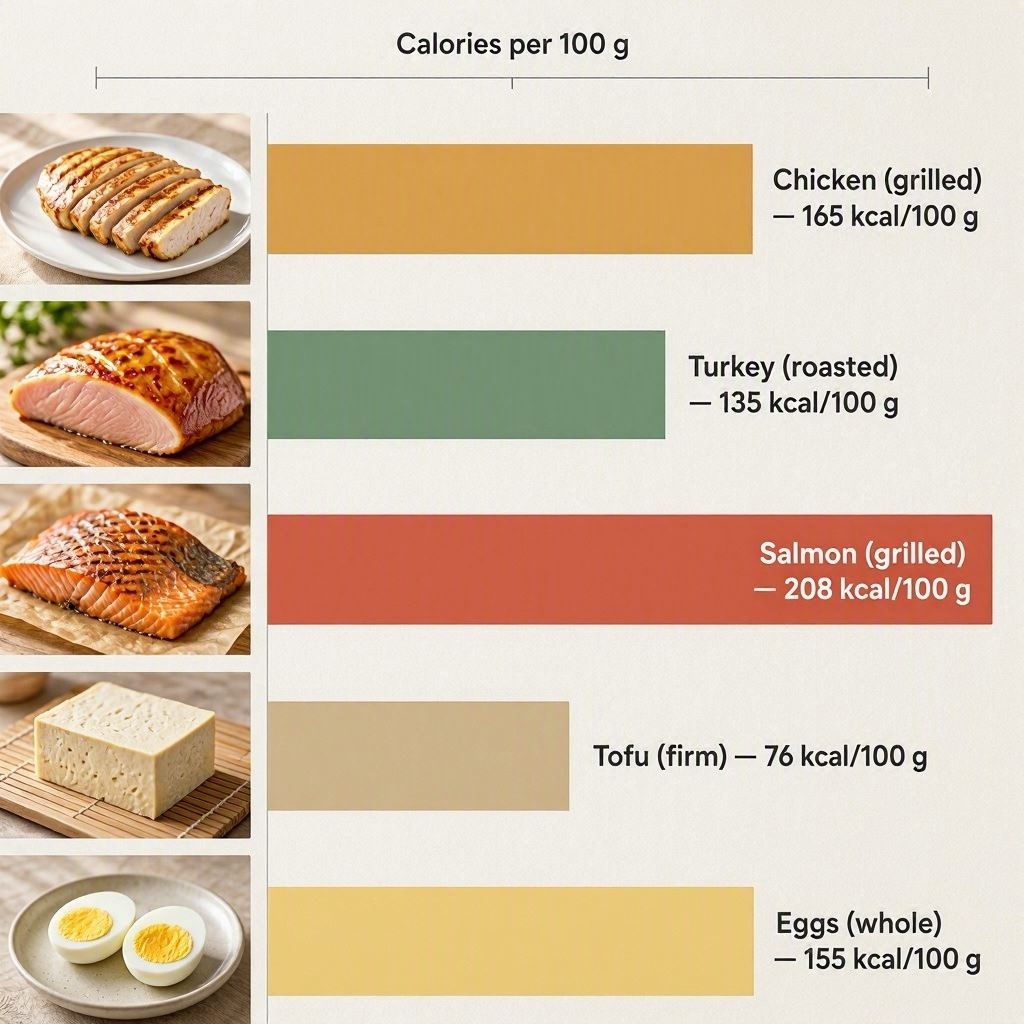
Per 100g cooked, chicken breast sits toward the leaner end of common protein sources — lower in calories than red meat or fatty fish, though not the absolute lowest option available.
| Protein (per 100g, cooked) | Calories |
|---|---|
| Firm tofu | 76 |
| Turkey breast, roasted | 135 |
| Chicken breast, grilled | 165 |
| Egg, boiled | 155 |
| Lean ground beef (93/7) | 172 |
| Salmon, baked | 206 |
These are approximate reference values for common preparations — exact numbers vary by specific cut, brand, and cooking method.
Chicken breast’s combination of low fat and very high protein is what keeps it a default choice in weight-management and muscle-building eating plans, even though leaner options like tofu exist.
Why the Calorie Count Can Vary
A few things move the number more than people expect:
- Raw vs. cooked — as covered above, cooking concentrates calories per gram since water is lost during cooking.
- Skin on or off — leaving the skin on adds roughly 30 calories per 100g, mostly from fat.
- Portion size within “one breast” — a single chicken breast can range from about 4 ounces to over 10 ounces depending on the bird and how it’s trimmed, which alone can shift the calorie count by 150+ calories.
- What it’s cooked in or with — a dry rub or a squeeze of lemon adds negligible calories; a butter baste, heavy marinade, or breading can add substantially more.
Chicken Breast and Protein Quality
Part of why chicken breast shows up so often in nutrition advice comes down to protein quality, not just the calorie count. It’s a complete protein, meaning it supplies all nine essential amino acids the body can’t produce on its own.
Harvard’s Nutrition Source specifically points to poultry as one of the better protein choices when compared to red and processed meat, noting that replacing red meat with sources like poultry, fish, beans, or nuts is linked to lower cardiovascular risk in long-term research. That’s not a reason to avoid red meat entirely, but it’s part of why lean poultry, chicken breast included, tends to come up as a default recommendation in protein-focused eating patterns.
Protein also has a higher thermic effect than fat or carbohydrate, meaning the body burns slightly more energy digesting it — one of the reasons high-protein foods like chicken breast are commonly paired with weight-management goals, alongside their contribution to satiety.
Best Ways to Keep Grilled Chicken Breast Low-Calorie
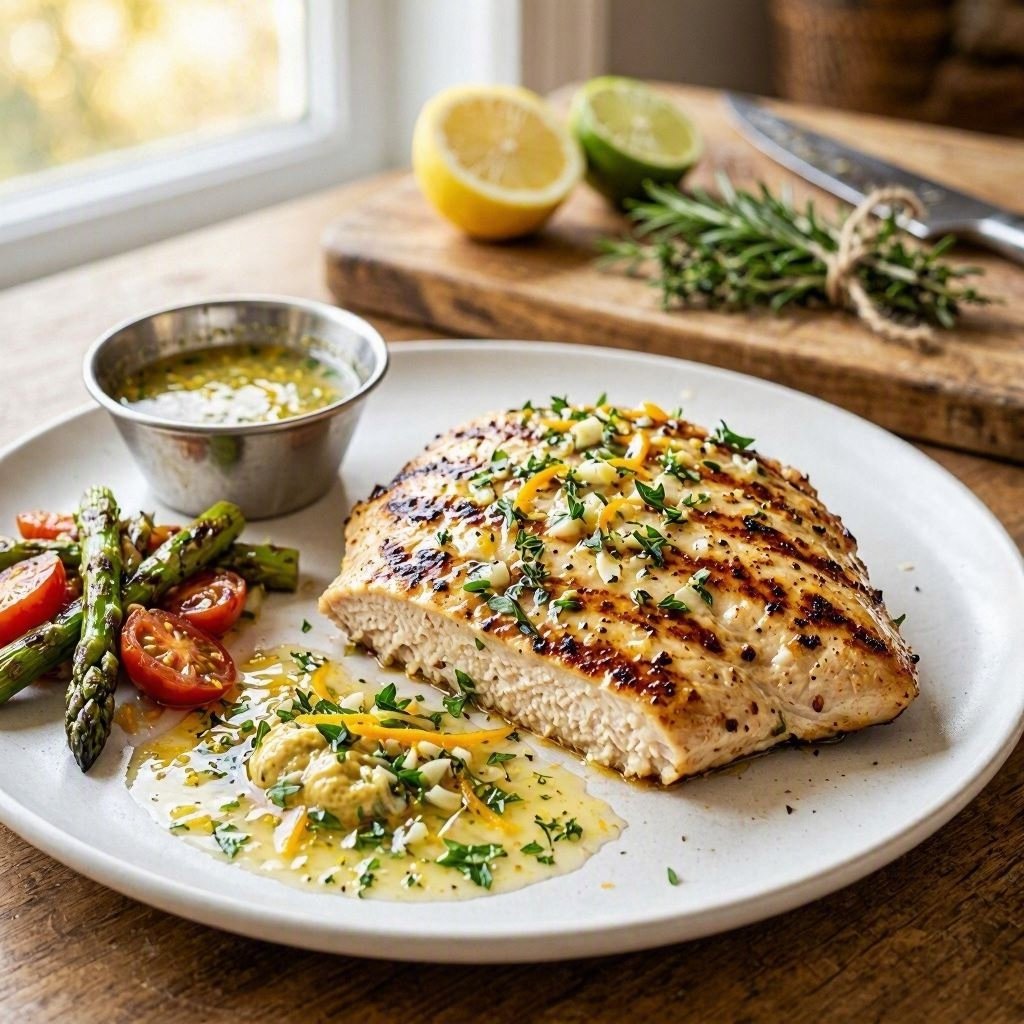
- Skip oil-heavy marinades — citrus juice, vinegar, and dry spice rubs add flavor without meaningfully raising the calorie count, unlike oil- or butter-based marinades.
- Watch sugary glazes and BBQ sauce — a sweet glaze can add 50–100+ calories to an otherwise lean piece of chicken.
- Trim visible fat and remove the skin before cooking rather than after, since it cooks into the meat less that way.
- Weigh or measure your portion — “one chicken breast” varies so much in size that eyeballing it is the easiest way to underestimate calories by a wide margin.
- Pair with vegetables rather than starchy sides if you’re trying to keep the overall plate lower in calories.
Storage and Prep Tips
- Raw chicken breast should go in the refrigerator immediately and be cooked within 1–2 days, or frozen at 0°F, where it stays safe indefinitely (though quality is best within a few months).
- Cooked chicken breast keeps 3–4 days in the refrigerator, or can be frozen for up to 4 months for best quality.
- Cook to a minimum internal temperature of 165°F, checked with a food thermometer — this is the safe minimum regardless of cooking method.
- Reheat leftovers to 165°F as well before eating, per USDA food safety guidance.
FAQ
How many calories are in one grilled chicken breast?
It depends heavily on size — a small breast (around 4 oz) has roughly 187 calories, while a large one (8 oz or more) can have 375 calories or more.
Is grilled chicken breast good for weight loss?
Its combination of low calories, zero carbs, and very high protein makes it a common choice in weight-management eating patterns — the protein in particular supports fullness better than many lower-protein foods of the same calorie count.
Does grilled chicken breast have fewer calories than baked?
No — grilling, baking, and roasting are all dry-heat methods that add essentially no calories on their own, so a plain chicken breast has about the same calorie count regardless of which of the three you use.
How many calories are in 4 oz of grilled chicken breast?
A 4-ounce serving of skinless grilled chicken breast has about 187 calories, 35g of protein, and 4.1g of fat.
Does chicken skin add a lot of calories?
Yes, relatively — leaving the skin on adds roughly 30 calories per 100g compared to skinless, mostly from fat.
Is raw chicken breast lower in calories than cooked?
Per equal weight, yes — but that’s misleading, since cooking removes water weight and concentrates the remaining nutrients. A 100g raw chicken breast and a 100g cooked chicken breast aren’t really the same “amount” of chicken.
How long can I keep grilled chicken breast in the fridge?
Cooked chicken breast is safe in the refrigerator for 3–4 days, or it can be frozen for up to 4 months for best quality.
Which has more calories, grilled chicken breast or salmon?
Baked salmon (about 206 calories per 100g) runs higher than grilled chicken breast (165 calories per 100g), mostly due to salmon’s higher fat content.
Bottom line: calories in grilled chicken breast come out to about 165 per 100g no matter how careful you are about portioning — it’s genuinely one of the leanest common proteins available, and the real calorie swings come from skin, breading, and sauces, not the chicken itself.
Related reading: How Many Calories Does a Green Grape Have? · Calories for a Grapefruit · Browse the Calories category
Sources:
- U.S. Department of Agriculture, FoodData Central — Chicken breast, cooked
- Harvard T.H. Chan School of Public Health, The Nutrition Source — Protein
- USDA Food Safety and Inspection Service — Chicken from Farm to Table
Reviewed by Chloe MacAllister, Certified Sports Nutritionist · Last updated August 31, 2026





 Trudy Banks
 Chloe MacAllister
[…] reading: Calories in Grilled Chicken Breast · Low Calories Non Alcoholic Beer · Browse all our Calorie […]